Introduction
OO-LD Schema aims to connect the structural modelling of objects and subobjects with the modelling of the semantic relations without reinventing the wheel. It therefore combines existing standards, primarily JSON Schema and a JSON-LD context in the same document.
What makes OO-LD different from other approaches that unify structure and semantics is that the artefact is the source: one document is at the same time a valid JSON Schema and a referenceable JSON-LD remote context, so there is no separate modelling language and no build step generating a schema and a context that then have to be kept in sync. The same holds at the instance level - an OO-LD instance is a valid JSON-LD document, and OO-LD-aware tooling resolves the IRIs it references into linked objects, so a stored graph can be navigated as objects.
Why OO-LD?
- OO-LD schema documents are supported by a wide range of existing tools (all JSON Schema and JSON-LD tooling!)
- OO-LD schema documents themselves follow linked data principles to make them retrievable over the web to allow flexible schema compositions
- OO-LD schemas allow generic ex- and import of RDF
- OO-LD schemas are compatible with LLM APIs
- OO-LD schemas can be used as function (dataclasses) and API signatures (OpenAPI)
- OO-LD schemas can be used to define graphical user interfaces, in particular forms
- OO-LD schemas turn a wiki or document store into a compounding, SPARQL-queryable knowledge base - the "LLM Wiki" pattern

JSON, JSON Schema and JSON-LD technology stack with OpenSemanticLab as example document store / platform
New to OO-LD? Head to Get Started below for a first hands-on example, then work through the Guide.
Guide vs. Specification
This site is the didactic, example-driven guide (primer). The normative, W3C-style Specification defines the conformance requirements (MUST/SHOULD) with defined terms and references. The two are cross-linked: use the guide to learn, the specification to cite.
Fundamentals
Design Goals and Rationale
Compatibility
An OO-LD document is always a valid JSON document. This ensures that all the standard JSON libraries work seamlessly with OO-LD documents.
An OO-LD instance document is always a valid JSON-LD document. This ensures that all the standard JSON-LD libraries work seamlessly with OO-LD instance documents.
An OO-LD schema document is always both a valid JSON Schema document and a JSON-LD remote context, so standard JSON Schema validators and JSON-LD processors work with it directly. One caveat: JSON Schema 2020-12 treats unknown keywords as annotations, but a validator that defaults to a strict mode (for example Ajv) rejects them, so it is run in non-strict mode or with the x-oold-* keywords registered.
Expressiveness
An OO-LD schema document allows the developer to express the syntax of a JSON instance document side by side with its semantics in a single source.
In addition, syntactical and semantic definitions can also be applied to external JSON instance documents that reference OO-LD schema documents.
This allows to specify well-defined patterns in a directed graph and enables tools relying on a hierarchical object structure to produce data for and consume data from such a graph.
Interoperability
OO-LD schema documents allow to specify all information that is needed to automatically transform data between semantically equivalent but syntactically different notations.
Related Work
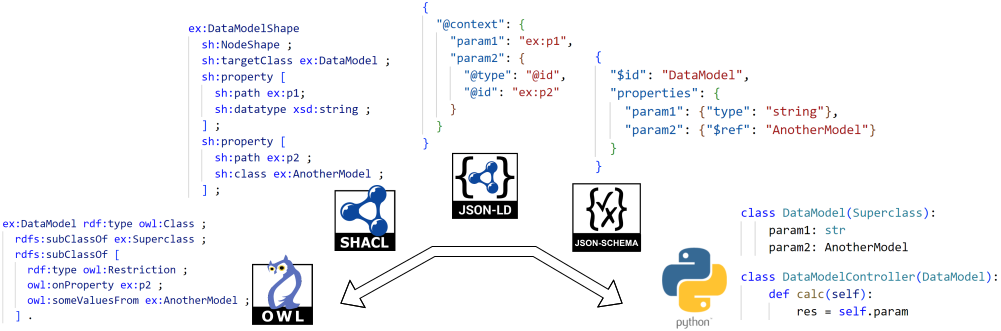
OO-LD as bridge between linked data and the general software domain
Data modelling is often described in three layers: conceptual (RDFS, OWL), logical (SHACL, ShEx) and physical (JSON Schema, XML Schema). OO-LD is a physical-layer artefact that carries enough conceptual annotation to generate the logical and conceptual layers from the same source. Rather than replacing frameworks like LinkML, SPDX or TreeLDR - which compile a bespoke source into a separate schema and context - OO-LD annotates JSON Schema in place and offers generated bridges (for example x-jsonld-* for OpenAPI and MCP delivery) to the forms other ecosystems expect. It therefore acts as an interlingua rather than yet another isolated syntax.
A detailed comparison with related schema languages and data models (OWL, SHACL, Asset Administration Shell, SAMM, LinkML, SPDX, Croissant, dlite, NOMAD, and more) is collected in the guide's Related Work tables.
Getting involved
Questions, ideas and design discussion are welcome - for now all in the issue tracker (one searchable place while the community is small):
- Question (usage, tooling, spec interpretation) - open an issue with the
questionlabel. - Open-ended discussion / proposal - open an issue with the
discussionlabel. - Bug or feature - open a regular issue.
- Contributions - pull requests are welcome; for larger changes, open a
discussionissue first.
JSON Schema and JSON-LD take the same approach on their spec repos, keeping questions and proposals as labelled issues. We'll consider GitHub Discussions or a chat once demand grows.
Get Started
This section walks you through the smallest possible OO-LD schema, step by step. If you are not familiar yet with JSON Schema or JSON-LD, you may first want to look at dedicated tutorials like the OSW JSON Schema Tutorial and the OSW JSON-LD Tutorial.
Step 1 - Write a schema that is also a context
The core idea of OO-LD is that a single document is at once a valid JSON Schema and a reference-able JSON-LD remote context. Start from a plain JSON Schema and add an @context:
- The JSON Schema part (
type,properties, …) describes the structure of the object. - The
@contextpart maps thenameproperty to the semantic termschema:name, describing its meaning. $idgives the schema a stable identity and$schemadeclares the OO-LD dialect (the meta-schema).
JSON or YAML?
JSON is the canonical notation for OO-LD. YAML is an equivalent, more human-friendly rendering as long as it stays within the JSON-compatible subset (no anchors, tags, or implicit typing surprises), so every example here has a "View as YAML" tab. See the specification's Notation section for the normative rule.
Step 2 - Try it in the playground
You can explore this exact example - validation, UI generation, and RDF output - in the interactive playground. The playground otherwise opens with the richer Person example; every official example under examples/ can be loaded the same way via ?schema=.
Step 3 - Validate schemas in this repository
This repository ships example schemas under examples/ and the OO-LD meta-schema under meta/. To validate them locally:
Next steps
- Basic Concepts - how a schema doubles as a context, and how inheritance works.
- Composition - assemble complex types from reusable building blocks.
- Schema Instances - how instance documents reference their schema and carry identity and type.